
The short version: Use NGFS Net Zero 2050 as a low-warming scenario for transition risks and IPCC SSP5-8.5 as a high-warming scenario for physical risks.
The Corporations Act now requires many companies to use climate scenario analysis, but its explanation of which scenarios to use is confusing and there is contradictory advice on the matter. This article steps through the legislation, clarifies the science, and summarises what companies are doing so you can decide for yourself.
What the legislation requires
The Corporations Act 2001 was revised in September 2024 to specify that certain companies need to submit a Sustainability Report. It leaves most of the details of what to put in the report to AASB S2, but it does specify that at least two warming scenarios must be used:
Here are those references from the Climate Change Act:
That is, you need to use a high-warming scenario that "well exceeds" "well below" 2°C. Someone must have thought that was a tad confusing because it was clarified that "An increase of 2.5°C or higher would be considered to well exceed the current increase mentioned in subparagraph 3(a)(i) of that Act."
To sum it up, according to law and guidance, you need to use a scenario that involves no more than 1.5°C of warming and one that involves at least 2.5°C of warming.
But what does that mean in practice? When companies use climate scenarios, they typically use a climate scenario associated with a credible organisation, and each of those scenarios comes with a warming label.
- High-warming scenario: "the increase in the global average temperature well exceeds the increase mentioned in subparagraph 3(a)(i) of the Climate Change Act 2022"
- Low-warming scenario: "the increase in the global average temperature is limited to the increase mentioned in subparagraph 3(a)(ii) of that Act."
Here are those references from the Climate Change Act:
- 3(a)(i): "holding the increase in the global average temperature to well below 2°C above pre‑industrial levels"
- 3(a)(ii): "pursuing efforts to limit the temperature increase to 1.5°C above pre‑industrial levels"
That is, you need to use a high-warming scenario that "well exceeds" "well below" 2°C. Someone must have thought that was a tad confusing because it was clarified that "An increase of 2.5°C or higher would be considered to well exceed the current increase mentioned in subparagraph 3(a)(i) of that Act."
To sum it up, according to law and guidance, you need to use a scenario that involves no more than 1.5°C of warming and one that involves at least 2.5°C of warming.
But what does that mean in practice? When companies use climate scenarios, they typically use a climate scenario associated with a credible organisation, and each of those scenarios comes with a warming label.
What the climate science says
Australian companies tend to use scenarios from one or more of the following sources:
Each of these institutions features 3-7 scenarios that result in different warming levels (and take different pathways to those warming levels). As you can see in the following figure, some - but not all - of these scenarios meet either the high or low warming definition in the Corporations Act.
- IPCC (Intergovernmental Panel on Climate Change)
- NGFS (Network for Greening the Financial System)
- IEA (International Energy Agency)
- AEMO (Australian Energy Market Operator)
Each of these institutions features 3-7 scenarios that result in different warming levels (and take different pathways to those warming levels). As you can see in the following figure, some - but not all - of these scenarios meet either the high or low warming definition in the Corporations Act.
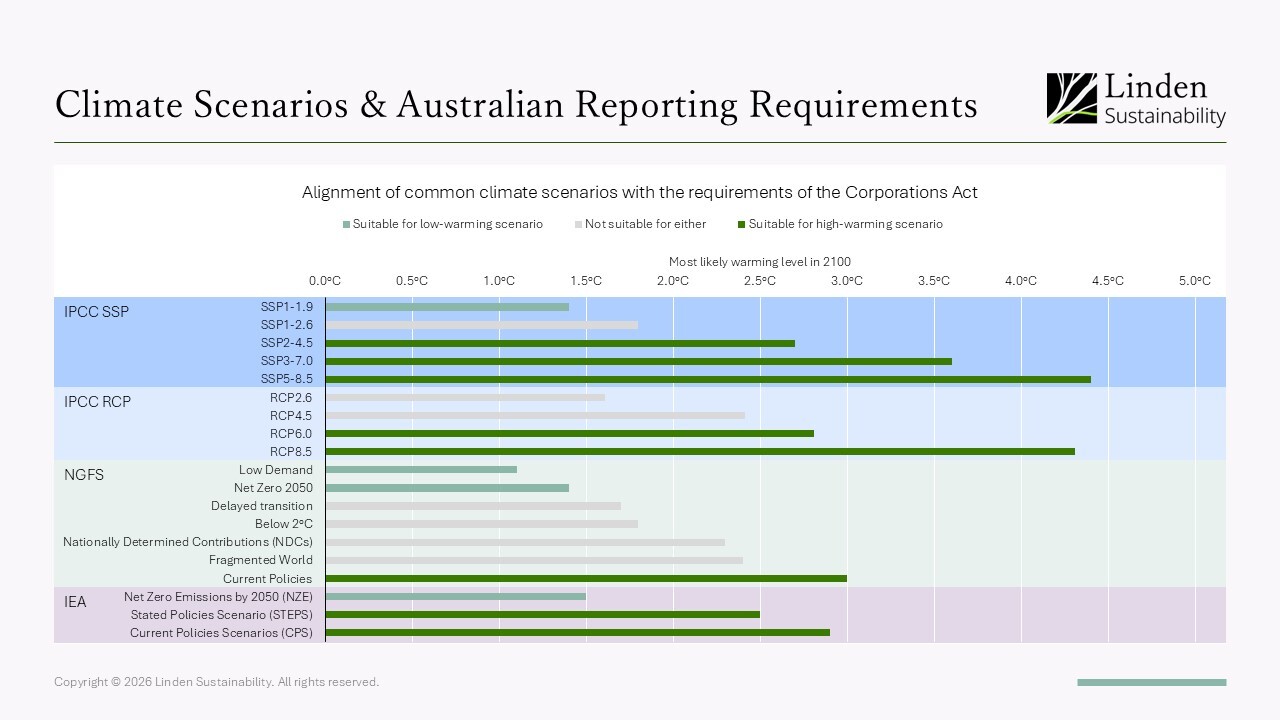
To get a bit technical for a moment, these warming levels are generally the median or best estimate increase in temperature between pre-industrial levels and around 2100 e.g. there is a 50% chance of ending up above or below that temperature. You might find other temperatures associated with each scenario based on other baseline periods or different chances of keeping warming below a certain level.
What companies are using
While there is a lot of variation in the climate-related disclosures released so far this year, companies are clustering around a relatively small number of scenarios, as can be seen in the following figure.
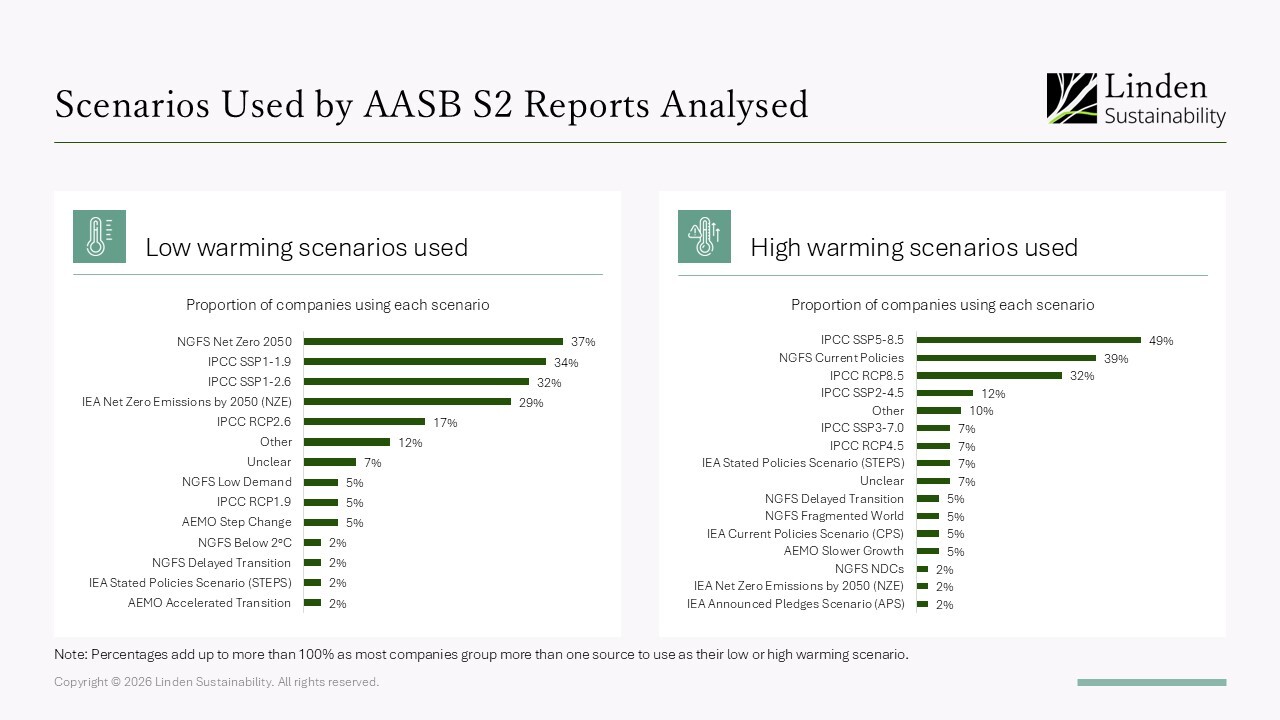
You might notice that many companies use RCP2.6 or SSP1-2.6, despite those scenarios arguably not meeting the requirements. But most pair it with another scenario like NGFS Net Zero, caveat that data wasn't available for SSP1-1.9, or provide other extensive justifications.
There is a lot more to climate scenario analysis than picking the right source, but it's one of the most difficult steps, and influences many of the following ones. Hopefully this article helps you start down the right path in your climate scenario analysis journey.
Disclaimer: This article is general information only, not legal or professional advice. Legislation and guidance may change. Seek independent advice before making disclosure decisions — Linden Sustainability accepts no liability for reliance on this article.