
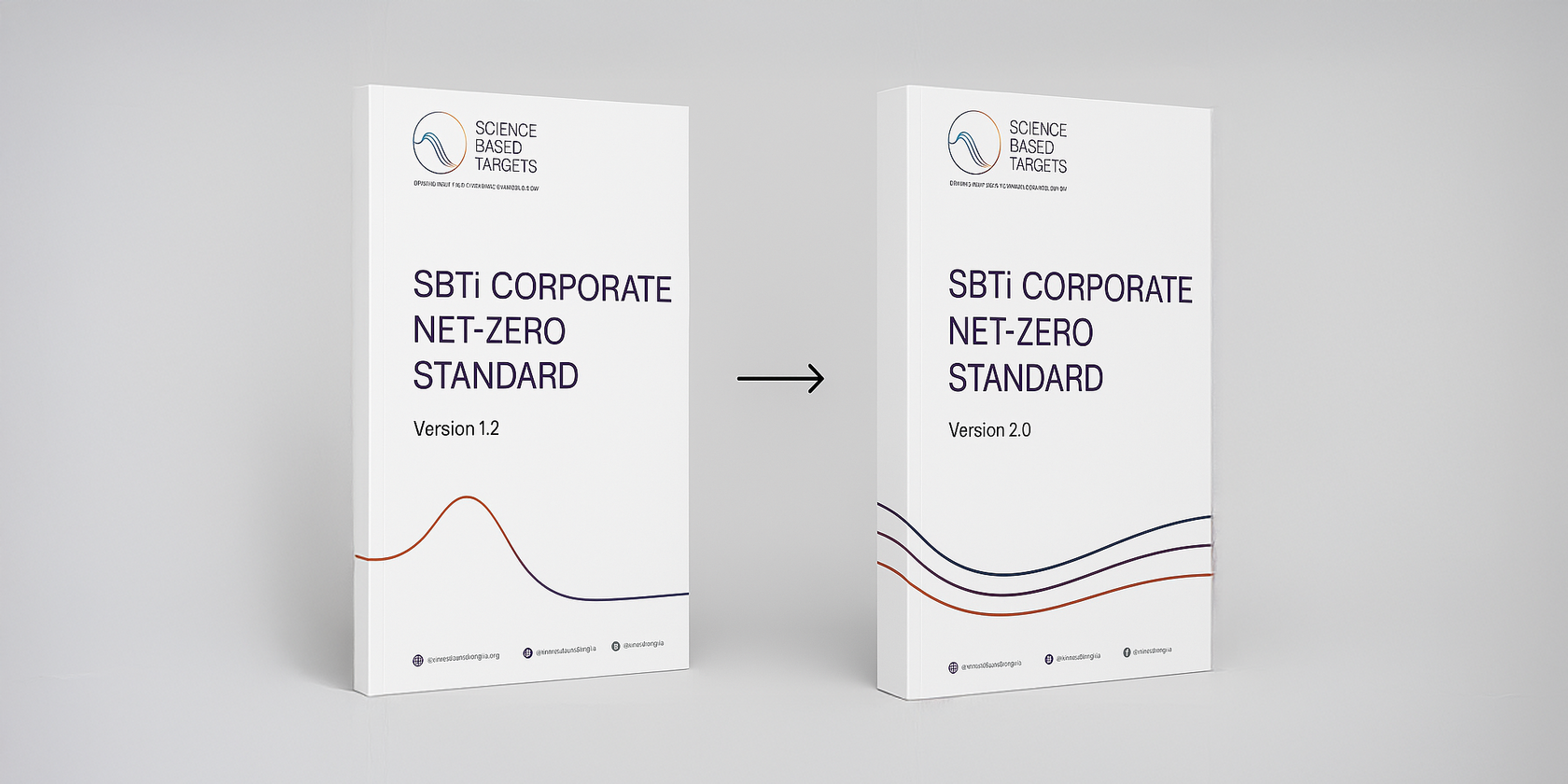
The Science Based Targets initiative (SBTi) has released a draft of its revised Corporate Net-Zero Standard for public consultation. The proposed update is a significant evolution of the previous standard and considerably raises the bar, requiring companies to follow a more rigorous transition pathway and meet stricter validation requirements.
Relevance Beyond Formal Validation
Even for companies not seeking formal SBTi validation, the results of this consultation process will be significant as SBTi's standards heavily influence investor and stakeholder expectations. Companies claiming science-aligned targets that diverge too much from these recommendations risk increased scrutiny and potential accusations of greenwashing. While SBTi doesn't hold exclusive rights to the term 'science-based,' it is widely regarded as an authoritative body in this space.
Understanding Categories A and B
The draft introduces a simplified categorisation of companies into Category A and Category B. Australian companies will fall into Category A if they have at least US$50 million (~A$80 million) in annual revenue and at least 250 full-time equivalent employees. These companies will be subject to the full set of requirements under the revised standard while Category B companies will have more flexibility. This article focuses on Category A companies, as they are the most affected by the proposed changes.
More Challenging Targets
Separate Scope 1 and 2 Targets
Under the current standard, companies can set combined Scope 1 and 2 emissions reduction targets. This approach benefits companies with significant Scope 2 emissions and smaller, harder-to-abate Scope 1 emissions, allowing them to offset slower progress in Scope 1 with faster reductions in Scope 2. The draft proposes requiring separate targets for Scope 1 and Scope 2 emissions, eliminating this flexibility and increasing the challenge for companies with difficult-to-reduce Scope 1 emissions.
New Carbon Removal Targets
Companies are presently required to neutralise their residual emissions at the net-zero target year using high-quality carbon dioxide removal (CDR) credits. SBTi is considering whether to require companies to start purchasing these credits immediately and ramp up over time.
Location-Based Scope 2 Targets
Previously, companies could choose between location-based or market-based approaches for Scope 2 emissions reduction targets. The draft proposes requiring both approaches.
Reducing location-based emissions is particularly challenging, as it depends on the local grid's emissions intensity, which companies cannot directly control. Companies can only reduce their location-based Scope 2 emissions by consuming less electricity or generating electricity on-site. Purchasing renewable electricity (e.g. Greenpower) only reduces market-based scope 2 emissions.
Reducing location-based emissions is particularly challenging, as it depends on the local grid's emissions intensity, which companies cannot directly control. Companies can only reduce their location-based Scope 2 emissions by consuming less electricity or generating electricity on-site. Purchasing renewable electricity (e.g. Greenpower) only reduces market-based scope 2 emissions.
Mandatory Long-Term Targets
Previously, companies could choose to only set short-term targets under the SBTi standard, with long-term (net zero) targets being optional. Under the draft update, companies will be required to set both near-term and long-term targets, unless their long-term target falls within the next five years. Long-term targets must still be set no later than 2050.
Accountability for Missed Targets
Companies renewing their SBTi targets may be required to account for underperformance against previous targets. This could involve setting more ambitious future reductions or purchasing additional carbon removals, depending on the consultation's outcome.
Evolving Scope 3 Requirements
Conditional Use of Market-Based Mechanisms
The draft proposes allowing market-based mechanisms, such as sustainable aviation fuel certificates, for meeting Scope 3 targets. However, these would need to be phased out over time, with phase-out dates yet to be determined. This is one of the few areas in which the proposed changes could make it easier to achieve SBTi-aligned targets, and one of the most controversial.
Enhanced Supplier Engagement
SBTi are considering introducing extensive supplier engagement requirements. For example, companies may be required to ensure that 100% of their Tier 1 suppliers involved in emissions-intensive activities are "transitioning" by 2030. This requirement could be particularly challenging for smaller companies with limited influence over their suppliers.
Improved Accuracy in Scope 3 Emissions Reporting
The draft emphasises the need for increased traceability and accuracy in Scope 3 emissions reporting over time. Companies would, for example, need to move from spend-based emissions factors to obtaining data directly from suppliers, especially for emissions-intensive activities. This requirement goes beyond the Australian reporting requirements, which allow for a high-level spend-based approach to be used.
Additional Reporting Requirements
Publication of Transition Plans
SBTi is proposing to require companies to publish a climate transition plan within a year of their targets being validated. Most companies with science-aligned targets already prepare internal transition plans, but producing a public version requires significant additional effort, especially in light of greenwashing risks.
SBTi is also considering whether to require or simply recommend that companies align their plans with standards like the UK’s Transition Plan Taskforce (TPT) framework, which is likely to be impractical for most Australian companies. Fortunately, it appears companies may instead be allowed to align with a local standard, such as the one currently being developed by the Australian Government.
SBTi is also considering whether to require or simply recommend that companies align their plans with standards like the UK’s Transition Plan Taskforce (TPT) framework, which is likely to be impractical for most Australian companies. Fortunately, it appears companies may instead be allowed to align with a local standard, such as the one currently being developed by the Australian Government.
Ongoing Progress Reporting
The draft standard expands SBTi’s role from validating targets to monitoring progress toward those targets. A new cyclical validation model will require companies to complete an “initial validation” when setting targets and a “renewal validation” at the end of each five-year cycle. At that point, companies will need to assess their performance, publicly communicate progress, and set new targets to bridge any remaining gap toward net zero. This includes providing evidence of measurable reductions, recalculating targets if needed, and potentially undergoing “spot checks” by SBTi.
The public consultation is open until 1 June 2025. Following this, SBTi will revise the draft based on feedback and launch a second round of consultation and pilot testing.
In the meantime, companies can continue to set targets using the current standard until the end of 2026. However, those targets will only remain valid until 2030, at which point companies will need to transition to the updated standard to maintain alignment with SBTi.
In the meantime, companies can continue to set targets using the current standard until the end of 2026. However, those targets will only remain valid until 2030, at which point companies will need to transition to the updated standard to maintain alignment with SBTi.