
After a long wait, Australia has its very own sustainable finance taxonomy. Now what?
Much of the current discussion centres around green bonds, but there’s another valuable use-case: climate reporting. Companies can leverage the taxonomy to report the proportion of revenue, capital expenditure, and operational expenditure linked to taxonomy-aligned activities.
In the EU, many large, listed companies and financial institutions are required to report taxonomy alignment. But in Australia, uptake will initially rely on voluntary adoption.
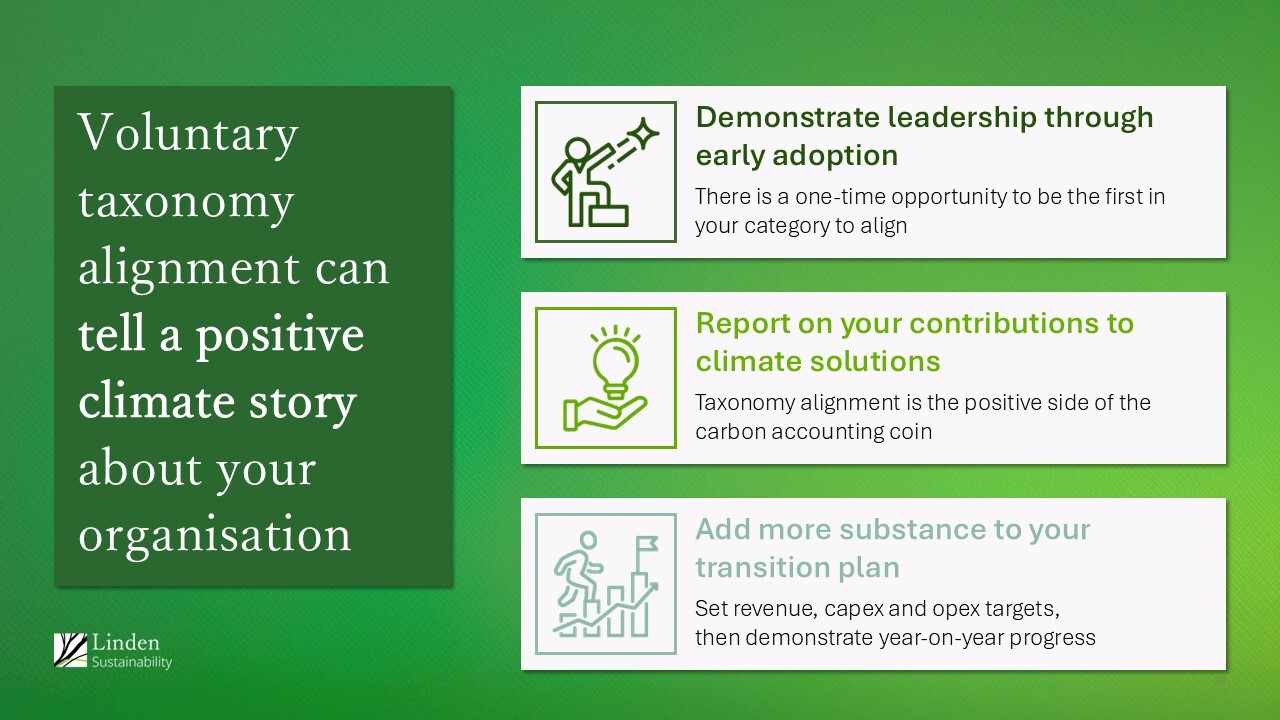
So why would companies voluntarily add taxonomy alignment to their already significant sustainability reporting to-do list? Simply put, because it offers a straightforward opportunity to share a positive climate narrative.
Reframing the Climate Conversation
Taxonomy alignment can be seen as the flip side of the carbon accounting coin. While greenhouse gas emissions reflect your negative impact on the climate, taxonomy alignment highlights your positive contributions toward climate solutions.
The two most logical places to communicate your taxonomy alignment are:
- Your annual climate report (mandatory or voluntary), alongside greenhouse gas emissions data.
- Your Climate Transition Action Plan (CTAP), showcasing alignment targets and progress.
But there's no need to wait on formal reporting cycles. Early adopters can follow the example set by companies like EnBW, who proactively published their alignment and experience using the EU Taxonomy early on.
The first organisations to adopt the taxonomy in Australia are likely to strengthen their reputation as sustainability leaders. While an official pilot program for the Australian Sustainable Finance Taxonomy is in progress, nothing prevents other organisations from assessing and publicising their alignment right now.
Taxonomy Alignment Might Be Easier Than You Think
A common reaction might be: “Sounds great, but we're already overwhelmed preparing for mandatory climate disclosures.” That’s understandable—but aligning with the taxonomy doesn't always require substantial additional effort.
The EU Taxonomy received criticism for its complexity and compliance burden. However, the Australian taxonomy addresses these concerns by offering flexibility: As long as they're transparent about their approach, companies can choose to align solely with the Technical Screening Criteria (TSC), avoiding the more onerous Do No Significant Harm (DNSH) and Minimum Social Safeguards (MSS) criteria.
There are also some synergies with mandatory climate reporting standards. Taxonomy alignment can support the AASB S2 requirement to report on exposure to and alignment with climate-related risks and opportunities.
How to Get Started
Here is a high-level guide to exploring your taxonomy alignment:
- Determine relevance: Identify if your primary sector or specific transition activities—such as renewable energy installations—are covered by the taxonomy.
- Decide alignment level: Choose whether you'll focus solely on the Technical Screening Criteria (TSC) or also incorporate all or some of DNSH and/or MSS.
- Assess and calculate: Begin the process of identifying applicable business activities, defining boundaries, and calculating the percentage alignment across key financial metrics.
Much of the climate conversation focuses on risks and emissions. The Australian sustainable finance taxonomy is a chance to shift that narrative—highlighting the opportunities your organisation is pursuing and the solutions it contributes to. Getting onboard early could also help position you as a leader in climate action.
Disclaimer: While I was a member of the Taxonomy Technical Expert Group (TTEG), the decision-making body for the Australian Sustainable Finance Taxonomy, any views expressed above are my own and all information shared is based on publicly available information. For official statements on the Australian Sustainable Finance Taxonomy, please contact ASFI directly.